AtaGenix Laboratories

AtaGenix Laboratories
Release time: 2025-07-14 View volume: 853
Project Snapshot — An immunology team investigating how the deubiquitinase USP8 regulates MDA5-mediated innate immunity needed a phospho-specific antibody targeting USP8 at Ser718. AtaGenix delivered a custom rabbit anti-phospho-USP8(S718) polyclonal antibody validated for Western Blot and Co-IP, enabling discovery of the AKT–USP8–MDA5 signaling axis — published in Advanced Science (2025).
Melanoma differentiation-associated protein 5 (MDA5) is a key intracellular RNA sensor that mediates type I interferon (IFN-I) production — a critical component of antiviral innate immunity. Dysregulation of MDA5 activity is implicated in autoimmune diseases including systemic lupus erythematosus and Aicardi–Goutières syndrome. A 2025 study published in Advanced Science (DOI: 10.1002/advs.202503865) revealed that AKT-mediated phosphorylation of the deubiquitinase USP8 at Ser718 promotes USP8 interaction with MDA5, stabilizing MDA5 protein levels and enhancing IFN-I signaling. This identified a previously unknown post-translational regulatory mechanism linking AKT signaling to innate immune activation.
The research team required: (1) a phospho-specific antibody capable of distinguishing USP8 phosphorylated at Ser718 from the unmodified form; (2) validated performance in Western Blot for quantitative detection of phosphorylation levels in HEK293T and THP1 cell models; (3) compatibility with Co-immunoprecipitation (Co-IP) assays to confirm AKT–USP8 physical interaction; and (4) batch-to-batch consistency to ensure reproducibility across multiple experimental stages of a long-term study.
Developing a phospho-specific antibody against USP8 Ser718 presented several difficulties:
AtaGenix designed a targeted phospho-antibody workflow:
The custom phospho-USP8(S718) antibody enabled the research team to demonstrate that AKT phosphorylates USP8 at Ser718, which in turn promotes USP8-mediated deubiquitination and stabilization of MDA5. This mechanism amplifies type I interferon production during viral infection. Critically, the study showed that dysregulation of this AKT–USP8–MDA5 axis contributes to autoimmune pathology, identifying USP8 Ser718 phosphorylation as a potential therapeutic target for autoimmune diseases driven by excessive IFN-I signaling. The findings were published in Advanced Science, a top-tier interdisciplinary journal.
Figure 1. AKT–USP8–MDA5 signaling axis. AKT-mediated phosphorylation of USP8 at Ser718 promotes USP8 interaction with MDA5, stabilizing MDA5 and enhancing type I interferon production during viral infection.
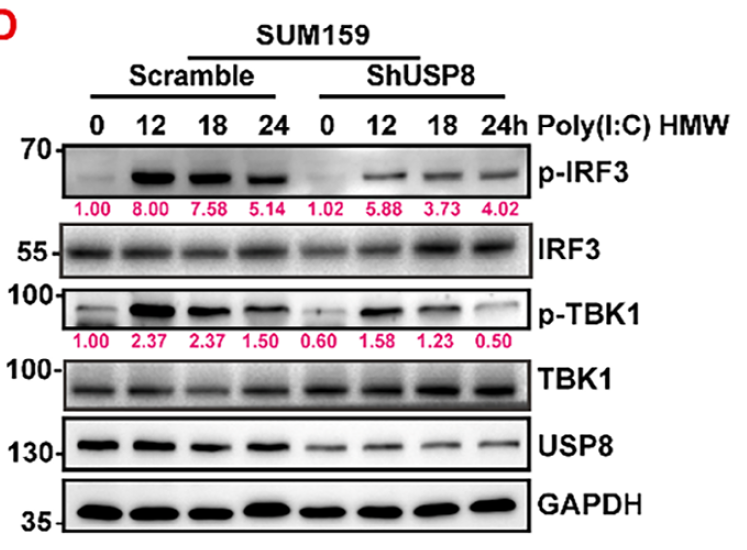
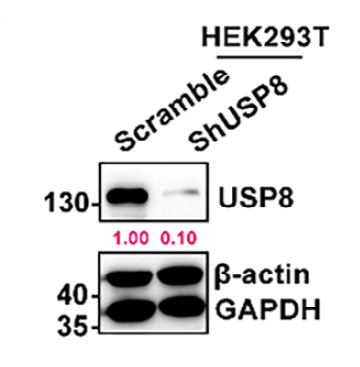
Figure 2. Validation of AtaGenix custom anti-phospho-USP8(S718) antibody. Left: Western Blot detection of USP8 Ser718 phosphorylation in HEK293T cells with AKT co-transfection. Right: antibody specificity confirmation.
About AtaGenix
AtaGenix specializes in custom phospho-specific antibody development, from phospho-peptide design and two-round affinity purification through multi-platform validation (WB, IP, Co-IP, IF, IHC). We support targets where no commercial phospho-antibody exists. Learn more at www.atagenix.com.
This case study is based on a published research collaboration. Results may vary depending on target protein, phosphorylation site, and experimental conditions. All proprietary client information is subject to NDA. Reference: Advanced Science. 2025. DOI: 10.1002/advs.202503865
Need a phospho-specific antibody for a signaling pathway target where no commercial reagent exists? AtaGenix delivers from phospho-peptide design to validated antibody with full Co-IP/WB protocol support.
Explore Anti-PTM Antibody Service
Contact Us

+86-27-65523339

info@atagenix.com

Building C, R & D Building, No. 666, Shendun 4th Road, Donghu New Technology Development Zone, Wuhan