AtaGenix Laboratories

AtaGenix Laboratories
Release time: 2024-11-05 View volume: 1290
Project Snapshot — A research team needed functional pMHC tetramers for antigen-specific T-cell detection. AtaGenix expressed HLA-I heavy chain and β2-microglobulin (β2M) in E. coli, refolded both components with target peptide to form stable pMHC complexes, and assembled streptavidin-based tetramers — delivering ready-to-use reagents for flow cytometry-based immune monitoring.
Identifying and quantifying antigen-specific T cells is central to immunology research, cancer immunotherapy, infectious disease monitoring, and vaccine development. But T-cell receptors (TCRs) bind their cognate peptide-MHC (pMHC) with low affinity — too weak for reliable detection with monomeric reagents. The solution: multimerize biotinylated pMHC monomers onto fluorescently labeled streptavidin to create tetramers, which increase avidity by presenting four pMHC units simultaneously. This transforms a weak interaction into a detectable signal on flow cytometry.
The challenge is that functional pMHC tetramers require every component — HLA heavy chain, β2M, and peptide — to fold correctly together. If any component misfolds, the peptide won't load, and the tetramer won't bind its target T cells. This makes pMHC production one of the most technically demanding applications in recombinant protein expression.
The client needed pMHC tetramers for a specific HLA-I allele loaded with a defined peptide epitope. Commercial tetramer services cover common HLA-A*02:01 alleles, but the client's allele was not available off-the-shelf. They required custom production from scratch: recombinant HLA heavy chain, β2M, optimized refolding with their peptide of interest, biotinylation for streptavidin conjugation, and final tetramer assembly with QC verification — all from a single provider to ensure batch-to-batch consistency.
AtaGenix leveraged its MHC-peptide complex expression technology to deliver the complete workflow:
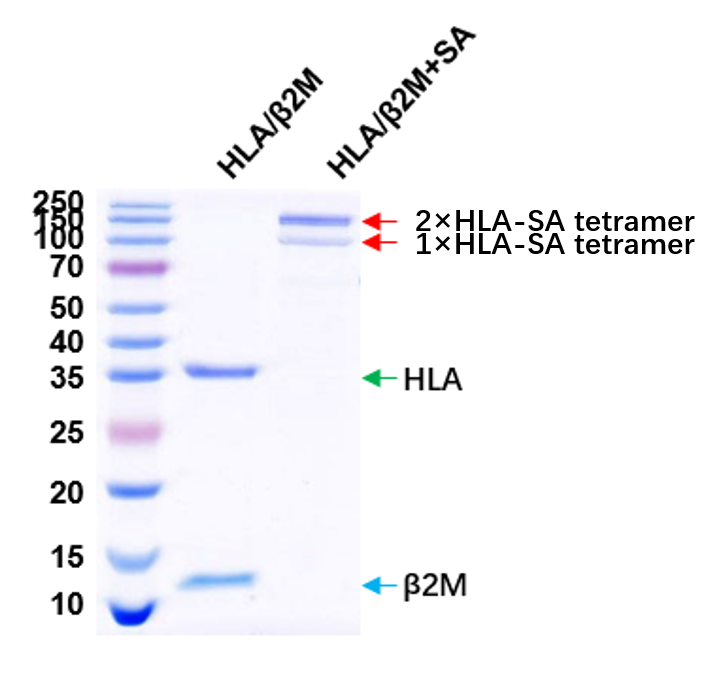
Figure 1. pMHC tetramer production workflow. HLA-I heavy chain and β2M were expressed in E. coli, refolded with target peptide to form stable pMHC monomers (HLA/β2M/peptide), biotinylated via BirA, and assembled into tetramers with streptavidin (SA). The resulting tetramers enable high-avidity detection of antigen-specific T cells by flow cytometry.
The assembled tetramers showed correct molecular weight profile by SEC (tetramer peak with minimal free monomer), and the client confirmed functional staining of antigen-specific CD8⁺ T cells by flow cytometry. By receiving the complete workflow from a single provider — expression, refolding, biotinylation, assembly, and QC — the client avoided the batch-to-batch variability that typically arises when different steps are performed by different labs.
Why This Matters
pMHC tetramer production sits at the intersection of protein expression, refolding science, enzymatic biotinylation, and molecular assembly — four disciplines that must work in concert. A failure at any step (misfolded HLA, incomplete peptide loading, random biotinylation, wrong SA:monomer ratio) produces a reagent that looks correct on a gel but fails to stain T cells. AtaGenix's integrated MHC-peptide complex platform controls every variable under one roof, giving immunology researchers access to custom tetramers for any HLA allele and any peptide — including alleles and epitopes that no commercial supplier stocks.
This case study represents an anonymized project outcome. Results may vary depending on HLA allele, peptide sequence, and downstream application. All client information is subject to NDA.
Need custom pMHC monomers, biotinylated complexes, or ready-to-use tetramers for T-cell detection? AtaGenix delivers the full workflow — from HLA expression through tetramer assembly and QC.
Discuss Your pMHC Tetramer ProjectResponse within 24 hours

Contact Us

+86-27-65523339

info@atagenix.com

Building C, R & D Building, No. 666, Shendun 4th Road, Donghu New Technology Development Zone, Wuhan